Flea markets are one of our favourite things in Japan. In Kyoto we know them well (see my Kyoto flea market guide), but in Tokyo they work differently. There is no single huge market that everyone goes to. Instead, a Tokyo flea market is usually smaller and takes place on a shrine courtyard, a temple approach or a plaza between office towers, almost every weekend somewhere in the city.
So far we have been to one of them: the Tokyo Romantic Market in Shibuya. More are firmly on our list for the next trip, and I will add our notes here once we have been. For everything else, the dates, times and details below come from the organisers and current market calendars (October 2026).
Which Tokyo Flea Market Should You Visit?
Pick a market by what you are after. All dates and opening times are in the calendar below.
- Only an hour or two: Tokyo Romantic Market in Shibuya, 2nd and 4th Sunday.
- Serious about antiques: Oedo Antique Market, Tomioka Hachimangu or the Gozare-ichi in Takahata.
- Cheap clothing and second-hand finds: Oi Racecourse, almost every weekend.
- Handmade gifts and pottery from the makers: Zoshigaya Tezukuri-ichi.
- Sunday in Shinjuku anyway: Hanazono Shrine.
- Travelling in December or January: Setagaya Boro-ichi.
Tokyo Flea Market Calendar: 11 Regular Markets
Each of these markets runs on a fixed rule, like “every 2nd and 4th Sunday”. The one exception is the Oedo Antique Market, which publishes its own dates. Times are as the organisers give them, and many sellers pack up earlier, especially in cold weather.
| Market | Where | When | Type |
|---|---|---|---|
| Tokyo Romantic Market | Shibuya Garden Tower, Shibuya | 2nd and 4th Sunday, 10:00 to 16:00 | antiques, vintage, jewellery, crafts |
| Oedo Antique Market | Tokyo International Forum, Yurakucho | about twice a month (see official dates), 9:00 to 16:00 | antiques |
| Oi Racecourse Flea Market | Oi Racecourse, Shinagawa | most Saturdays and Sundays, 9:00 to 14:30 | second-hand, clothing |
| Hanazono Shrine Antique Market | Hanazono Shrine, Shinjuku | almost every Sunday, from early morning to about 16:00 | antiques |
| Tomioka Hachimangu Antique Market | Tomioka Hachimangu, Monzen-Nakacho | 1st, 2nd, 4th and 5th Sunday, 6:00 to 15:00 | antiques, second-hand |
| Arai Yakushi Antique Market | Baishoin Temple, Nakano | 1st Sunday, 6:00 to 15:00 | antiques |
| Shinmeigu Garakuta-ichi | Asagaya Shinmeigu Shrine, Suginami | 1st Saturday, early morning to early afternoon | antiques, odds and ends |
| Zoshigaya Tezukuri-ichi | Kishimojin-do, Zoshigaya | usually 3rd Sunday, 10:00 to 16:00 | handmade crafts |
| Takahata Fudo Gozare-ichi | Takahata Fudoson Temple, Hino | 3rd Sunday, 7:00 to 15:00 | antiques |
| Tama Antique Market | Suwa Shrine, Tachikawa | 4th Sunday (not in August), 7:00 to 14:30 | antiques |
| Machida Tenmangu Garakuta-ichi | Machida Tenmangu Shrine, Machida | 1st of every month (not in January), from early morning | antiques |
Almost every outdoor Tokyo flea market is cancelled in rain, and dates move when a shrine holds a festival. Check the organiser’s website or social media on the morning you go. For the shrine and temple markets, fmfm.jp keeps an up-to-date calendar (in Japanese, but the dates are easy to read).
Kotto-ichi means antique market, nomi no ichi flea market, garakuta-ichi roughly “junk market” and tezukuri-ichi handmade market. Japanese event listings use these words, so they help when you search.
Tokyo Romantic Market: Our Pick for a Short Stroll
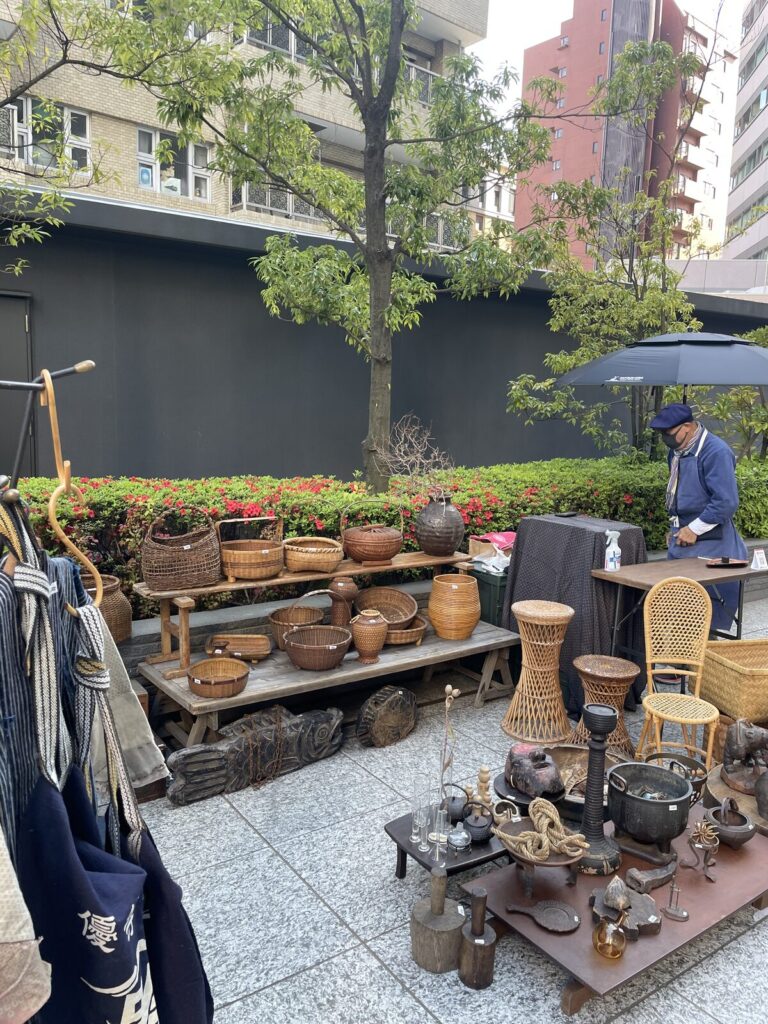
The Tokyo Romantic Market (東京浪漫・渋谷蚤の市, also called Shibuya Flea Market) is the one Tokyo flea market we have visited ourselves. It takes place on the 2nd and 4th Sunday of the month in the garden plaza of Shibuya Garden Tower, a short walk from Shibuya Station.
It is rather small, but very pretty. There are lots of little stalls, and each one has a completely different mix of things. Many of them sell antiques, and there are plenty of jewellery stalls too.
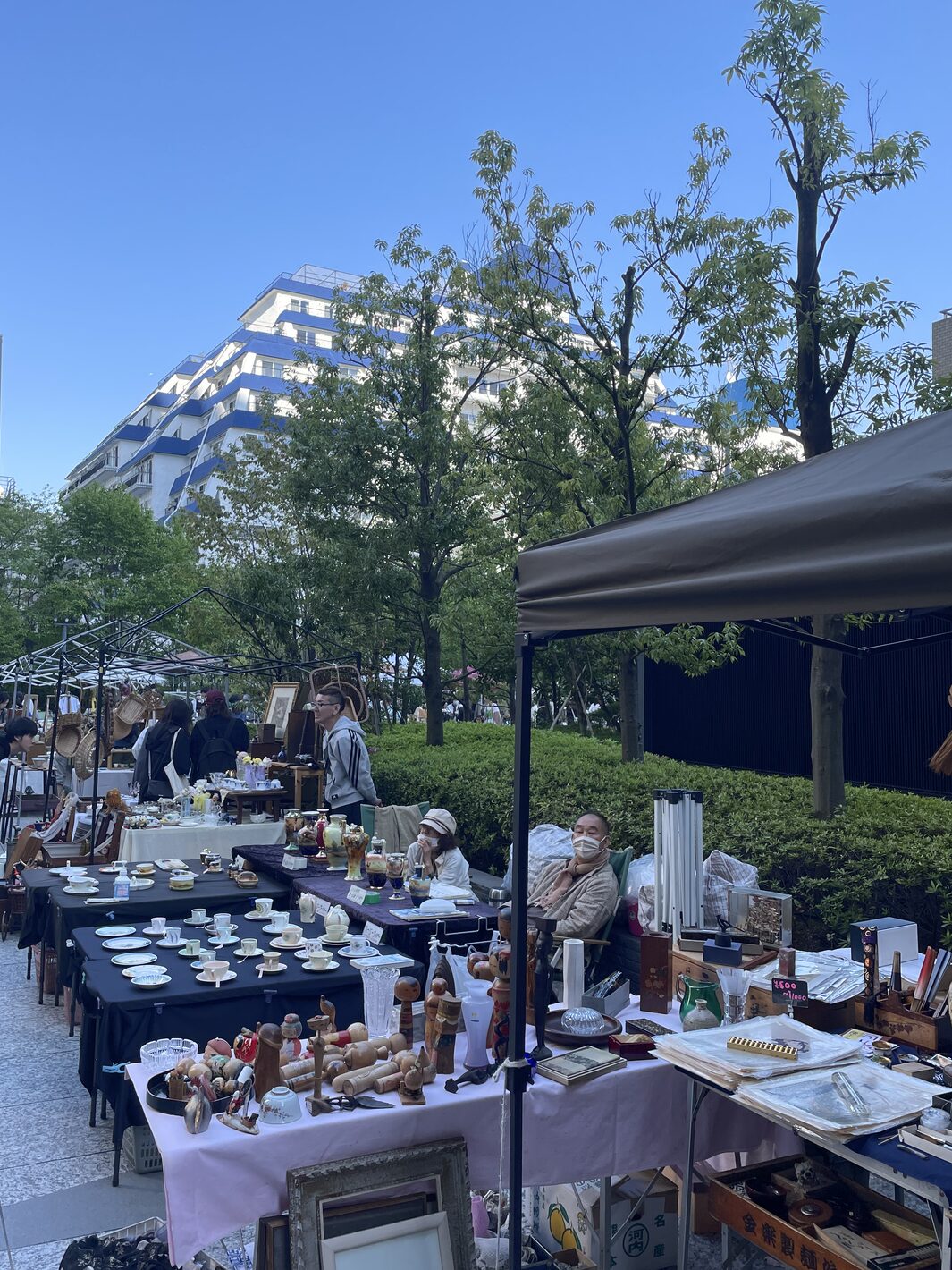
One stall had old bamboo and wicker baskets lined up on low wooden benches, with cast-iron kettles and pots on a table in front, a rattan chair, wicker stools and old indigo fabrics on a rack. A few tables further on, the antiques were more Western: teacups and saucers, painted vases, glassware and old picture frames, next to rows of kokeshi, the wooden dolls from northern Japan. The stalls stand under small tents on a plaza between trees and hedges.
If you only want to wander around a flea market for a short while, this is the one we recommend. You can see it in an hour without rushing, and Shibuya is on almost every Tokyo itinerary anyway. According to the organisers, around 100 sellers come each time, with antiques from Japan, Europe and elsewhere, handmade accessories, art, plants and organic food.
Tokyo Romantic Market in short: 2nd and 4th Sunday, 10:00 to 16:00, free entry. Next dates: 8 and 22 November, 13 and 27 December 2026. Dates and rain cancellations are on the official website.
Oedo Antique Market: The Biggest Antique Market in Tokyo
The Oedo Antique Market (大江戸骨董市) is the biggest antique market in Tokyo, with around 250 dealers. It fills the open plaza of the Tokyo International Forum in Yurakucho, one minute from Yurakucho Station and about five minutes on foot from Tokyo Station.
Expect ceramics, old kimono and fabrics, Edo-period objects, furniture and plenty of small things. The sellers are professional dealers, so this is an antique market rather than a jumble sale.
The Oedo Antique Market used to run on the 1st and 3rd Sunday. Today it has no fixed weekday, so look up the dates before you plan around it. The remaining 2026 dates are 31 October, 7 and 23 November, and 12 and 20 December. In August it takes a break because of the heat.
Oedo Antique Market in short: about twice a month, 9:00 to 16:00, free entry, cancelled in rain. Dates are on the official website. Only a few dealers take cards. Ginza is a short walk away if you want to continue from there.
Oi Racecourse Flea Market: For Bargain Hunters
The flea market on the car park of Oi Racecourse in Shinagawa is the opposite of the Oedo Antique Market. It is a real second-hand market: lots of clothing, household goods, toys and whatever people cleared out of their homes. Proper antiques are rare.
Many sellers start packing up around noon, so come in the morning. Some weekends are skipped because of race events.
Oi Racecourse Flea Market in short: most Saturdays and Sundays, 9:00 to 14:30, free entry, cancelled in rain. Three minutes on foot from Oi Keibajo-mae on the Tokyo Monorail. Dates are on the organiser’s website trx.jp.
Shrine and Temple Markets in Central Tokyo
The classic Tokyo flea market takes place on the grounds of a shrine or temple. These markets are smaller than the ones in Kyoto, usually between 25 and 100 stalls, and most of them start very early. Many dealers set up before sunrise and start packing up in the early afternoon.
Hanazono Shrine (Shinjuku)
Hanazono Shrine sits between the department stores of Shinjuku-sanchome and Golden Gai. Its antique market runs almost every Sunday with about 25 to 30 stalls. It is small, but you can easily fit it into a day in Shinjuku. It does not take place on festival days or in rain.
Tomioka Hachimangu (Monzen-Nakacho)
Tomioka Hachimangu in Fukagawa has one of the largest shrine markets in the city, with over 100 stalls of antiques and old odds and ends. It runs on the 1st, 2nd, 4th and 5th Sunday of the month, roughly from 6:00 to 15:00. When the date falls on the 15th or 28th, there is a regular flea market instead. The shrine is three minutes from Monzen-Nakacho Station.
Arai Yakushi (Nakano)
The antique market at Arai Yakushi Baishoin Temple has been running for around 50 years. It takes place on the 1st Sunday of the month from 6:00 to 15:00 (in January on the 2nd Sunday). Expect Japanese and Western ceramics, old household tools, jewellery and kimono. The temple is five minutes from Arai-Yakushimae Station on the Seibu Shinjuku Line.
Asagaya Shinmeigu
Asagaya Shinmeigu holds its Garakuta-ichi on the 1st Saturday of the month. According to the shrine, the market usually ends shortly after noon, and earlier in bad weather, so this is one for early risers. Asagaya itself is a quiet neighbourhood on the JR Chuo Line.
The markets take place on sacred ground, so the usual rules apply: walk around the main hall quietly and do not eat in front of it. My guide to temple etiquette in Japan explains the basics.
Zoshigaya Tezukuri-ichi: Handmade Crafts
The Zoshigaya Tezukuri-ichi is the Tokyo version of the handicraft markets we love in Kyoto. Everything is made by the people selling it: pottery, jewellery, textiles, woodwork, prints and baked goods. It started in 2006, so 2026 is its 20th year, and around 160 makers take part.
If you liked the Kamigamo handicraft market in my Kyoto flea market guide, this is the closest thing to it in Tokyo.
Zoshigaya Tezukuri-ichi in short: usually the 3rd Sunday, 10:00 to 16:00, on the grounds of Kishimojin-do. The date changes in some months, so check before you go. Cancelled in rain. Take the Toden Arakawa tram to Kishibojin-mae, or the Fukutoshin Line to Zoshigaya Station.
Day Trip to Western Tokyo: Takahata, Tachikawa and Machida
Three of the larger antique markets are in western Tokyo, 40 to 60 minutes by train from Shinjuku. They are worth the trip if you are serious about antiques. If you just want a look at a Tokyo flea market, the markets in the centre are easier.
Takahata Fudo Gozare-ichi
The Gozare-ichi has been held at Takahata Fudoson Temple in Hino since 1988. It takes place on the 3rd Sunday from 7:00 to 15:00, with around 100 dealers selling ceramics, kimono, kokeshi dolls, old furniture and clocks. The temple is two minutes from Takahata-Fudo Station on the Keio Line, and its five-storey pagoda is worth a look on its own.
Tama Antique Market (Tachikawa)
The Tama Antique Market takes place on the grounds of Suwa Shrine in Tachikawa on the 4th Sunday of the month, from 7:00 to 14:30. In August it takes a break, and it is cancelled in rain. Expect Japanese and Western antiques, kimono, old toys and coins. The shrine is about ten minutes on foot from the south exit of JR Tachikawa Station.
Machida Tenmangu Garakuta-ichi
Machida Tenmangu holds its market on the 1st of every month, except in January, regardless of the weekday. With over 120 stalls it is one of the bigger markets in the Tokyo area. The shrine is close to Machida Station (JR Yokohama Line and Odakyu Line).
Once a Year: Setagaya Boro-ichi and Heiwajima Antiques Fair
Setagaya Boro-ichi is the oldest market on this list. It started in 1578 and is listed as an intangible folk cultural property. It takes place on just four days a year, on 15 and 16 December and 15 and 16 January, from 9:00 to 20:00. Around 700 stalls line the streets near Kamimachi Station on the Tokyu Setagaya Line, selling everyday goods, old tools, plants, toys and antiques. It is very crowded, especially at the weekend. Details are on the official page (Japanese).
Heiwajima Antiques Fair is an indoor antique fair at the Tokyo Ryutsu Center, held about five times a year over a weekend from 10:00 to 17:00. The next one is on 5 and 6 December 2026. Because it is indoors, it also takes place in rain. Take the Tokyo Monorail to Ryutsu Center Station.
Tips for Your First Tokyo Flea Market
Bring cash. Most sellers are one-person businesses and only take cash. Bring small notes and coins. At the Oedo Antique Market a few dealers take cards, but do not count on it.
Come early. The shrine and temple markets start at dawn, and many dealers pack up from early afternoon. The Tokyo Romantic Market is the exception, as it opens at 10:00.
Check for rain. Outdoor markets are cancelled in rain, sometimes on the morning itself. Most organisers post this on their website or Instagram.
Ask before taking photos. Some dealers do not want their goods photographed. A short question, or pointing at your camera, is enough.
Bargain politely, if at all. At antique markets a small discount is sometimes possible when you buy several things. Hard haggling is not common in Japan.
Bring a bag. Sellers wrap ceramics in newspaper, but rarely have bags. For the flight home, pack pottery between your clothes in the suitcase.
Mobile data. Since markets are cancelled at short notice, it helps to check the organiser’s page on the go, and Google Maps helps you find the smaller shrines. We use an eSIM. Saily (affiliate link) gives you 10% off with my code MOCHIMILES, applied automatically through the link. I compare the options in my eSIM guide for Japan.
Vegan food nearby. Flea market food stalls change every time, and many snacks contain dashi or egg, so ask before you buy. A good combination on a weekend is the Farmer’s Market at UNU in Aoyama, which runs every Saturday and Sunday and has a small antique corner too. For a proper meal, see vegan Tokyo and my guide to how to eat vegan in Japan.
If you like browsing second-hand shops, Shimokitazawa is Tokyo’s vintage neighbourhood and a good plan for a day without a market.
FAQ
What is the biggest flea market in Tokyo?
The Oedo Antique Market at the Tokyo International Forum is the biggest regular antique market, with around 250 dealers. Once a year, the Setagaya Boro-ichi is even bigger, with around 700 stalls.
Is there a flea market in Tokyo every weekend?
Yes. The Oi Racecourse flea market runs on most weekends, and Hanazono Shrine has an antique market every Sunday. On most Sundays there are several more.
When is the Oedo Antique Market?
About twice a month, but on changing days. The remaining 2026 dates are 31 October, 7 and 23 November, and 12 and 20 December, from 9:00 to 16:00. There is no market in August.
Do Tokyo flea markets take place when it rains?
Mostly not. Outdoor markets are cancelled in rain. The Heiwajima Antiques Fair is held indoors and is not affected.
Which Tokyo flea market is best for a short visit?
The Tokyo Romantic Market in Shibuya. It is small, central and open from 10:00, so you can easily fit it into a day in Shibuya.