In every onsen we have been to, nobody went straight into the water. Everyone sat down on a small stool first and scrubbed. That one habit explains most of the rules. This guide to onsen in Japan covers the rest: onsen etiquette step by step, tattoo friendly onsen options, private onsen, what to expect in an onsen ryokan, and how an onsen differs from a sento or a foot bath.
Most of the onsen in Japan we have used so far were hotel baths, private baths right in our room, and one separated mountain onsen for men and women. We also stayed at a ryokan in the middle of nowhere in Saga, which gave us our most awkward dinner in Japan. More on that below.
For the rules, I did not rely on memory. I checked them against the Japan National Tourism Organization (JNTO), the Japanese Onsen Association and the Japan Tourism Agency.
In this guide
- Onsen, Sento, Ryokan Bath, Foot Bath: What Is the Difference?
- Onsen Etiquette in Japan: Step by Step
- Tattoo Friendly Onsen: What Are Your Options?
- Private Onsen in Japan: Our Favourite Way to Bathe
- Onsen Ryokan as a Vegan: Our Biggest Fail
- Onsen Tamago: Not Vegan, but Everywhere
- Foot Baths: Onsen Without Undressing
- Popular Onsen Towns in Japan
- Where to Try an Onsen in Tokyo
- Onsen FAQ
Onsen, Sento, Ryokan Bath, Foot Bath: What Is the Difference?
In English everything gets called “hot spring”. For onsen in Japan, though, these are different things, and the difference even has a legal basis.
- Onsen (温泉): Under Japan’s Hot Springs Act, water from the ground counts as onsen if it is at least 25°C at the source or contains certain minerals in defined amounts. So even a cool mineral spring can legally be an onsen.
- Sento (銭湯): A neighbourhood public bathhouse, regulated under a separate law. Most use ordinary heated water, not spring water. The entry price is set by each prefecture, so a sento is usually the cheapest bath you will find.
- Super sento: Large bathing complexes with many pools, saunas, a restaurant and relaxation rooms. Some use real hot spring water, some do not. Prices are higher and not regulated.
- Ryokan bath: The shared bath in an onsen ryokan or other traditional inn, usually separated by gender, often with an outdoor bath (rotenburo).
- Kashikiri-buro (貸切風呂): A private bath you book for a time slot, or a bath that belongs to your own room.
- Ashiyu (足湯): A foot bath. You stay dressed and only put your feet in.
So for sento vs onsen: onsen describes the water, sento describes a type of bathhouse. A sento can use onsen water, but most do not.
Onsen Etiquette in Japan: Step by Step
Most onsen etiquette follows from one fact: everyone shares the same water, so it has to stay clean. The steps below apply to almost every public onsen in Japan and follow JNTO and the bathing poster of the Japanese Onsen Association.
- Check the curtain. Entrances are separated by gender. Look for the kanji 男 (men) and 女 (women). The colours, often blue for men and red for women, are common but not guaranteed.
- Undress completely. Clothes, underwear and swimwear stay in the basket or locker in the changing room. Swimsuits are not allowed in a regular onsen.
- Take only the small towel. It is for covering up on the way and for washing. The big towel stays in the changing room.
- Wash first, properly. Sit on the small stool at the washing station and scrub your whole body with soap, wash your hair and rinse everything off. This is the rule I would never skip.
- Pour water over yourself (kakeyu). The Onsen Association recommends three to five scoops of bath water over your body before you get in, so your body can adjust to the heat.
- Get in slowly. No jumping, no swimming, no splashing.
- Keep towel and hair out of the water. Fold the towel on your head or put it on the edge of the bath. Tie up long hair.
- Keep it quiet. Talking is fine, loud is not.
- No phones, no photos. Cameras are not allowed in bathing areas, for the privacy of other guests.
- Dry off before the changing room. Use your small towel to wipe off the water so you do not drip on the floor.
Two health rules from the same sources: do not drink alcohol before bathing, and drink water before and after. Do not stay in too long. Several short rounds with breaks on the edge are easier on your body than one long soak. If you feel dizzy, get out.
Staff and other guests will usually help if you get something wrong. If you are also visiting temples and shrines, my guide to temple etiquette in Japan covers the rules there.
Female Onsen Etiquette and Mixed Baths
Almost every public onsen in Japan is separated by gender, so as a woman you bathe only with women. The rules are the same for everyone. Long hair goes up, and makeup should come off at the washing station.
Mixed baths (konyoku) still exist in some traditional hot spring areas, but they are rare, and some of them allow bathing wraps or towels. If you are unsure, a private onsen is the relaxed option for couples and families.
Tattoo Friendly Onsen: What Are Your Options?
We do not have tattoos ourselves, so this part is not from experience. It is what the official sources say.
Tattoos are the trickiest part of visiting an onsen in Japan. They are still often linked to organised crime, and many baths refuse guests with tattoos. In a 2015 survey by the Japan Tourism Agency, about 56 percent of the hotels and inns that answered did not let guests with tattoos into their shared baths. In 2016 the agency asked operators to be more welcoming to foreign guests with tattoos.
It suggested cover stickers, private baths or separate time slots, and pointed out that tattoo ink does not dirty the water. It is a request, not a law, so every onsen in Japan still decides for itself.
That leaves you four realistic options:
- Cover stickers: Only work for small tattoos. Senkyaku Banrai Toyosu Manyo Club in Tokyo, for example, allows a maximum of two stickers of 11 × 20 cm per person, sold at the front desk. If your tattoo is bigger than that, you cannot enter.
- Private onsen: A kashikiri-buro or a room with its own bath avoids the question entirely.
- Tattoo friendly onsen and sento: More places openly accept tattoos now, especially smaller neighbourhood sento. Beppu, one of Japan’s most famous onsen towns, even published a city map with around 100 tattoo-friendly baths in 2018.
- A guided visit: If you do not want to research it yourself, there is a tattoo-friendly onsen experience in Tokyo (affiliate link) near Oshiage Station, where a guide takes you to a bathhouse that accepts tattoos and explains the routine. It is rated 4.9 out of 5. We have not done it ourselves.
Whatever you choose, check the rules of the specific bath before you go, even at a tattoo friendly onsen. Policies change, and an old blog list is not a guarantee.
Private Onsen in Japan: Our Favourite Way to Bathe
Most of our onsen baths so far have been private ones. Many hotels and onsen ryokan offer kashikiri baths you can book by the hour, and some rooms have their own small hot spring bath on the balcony or terrace.
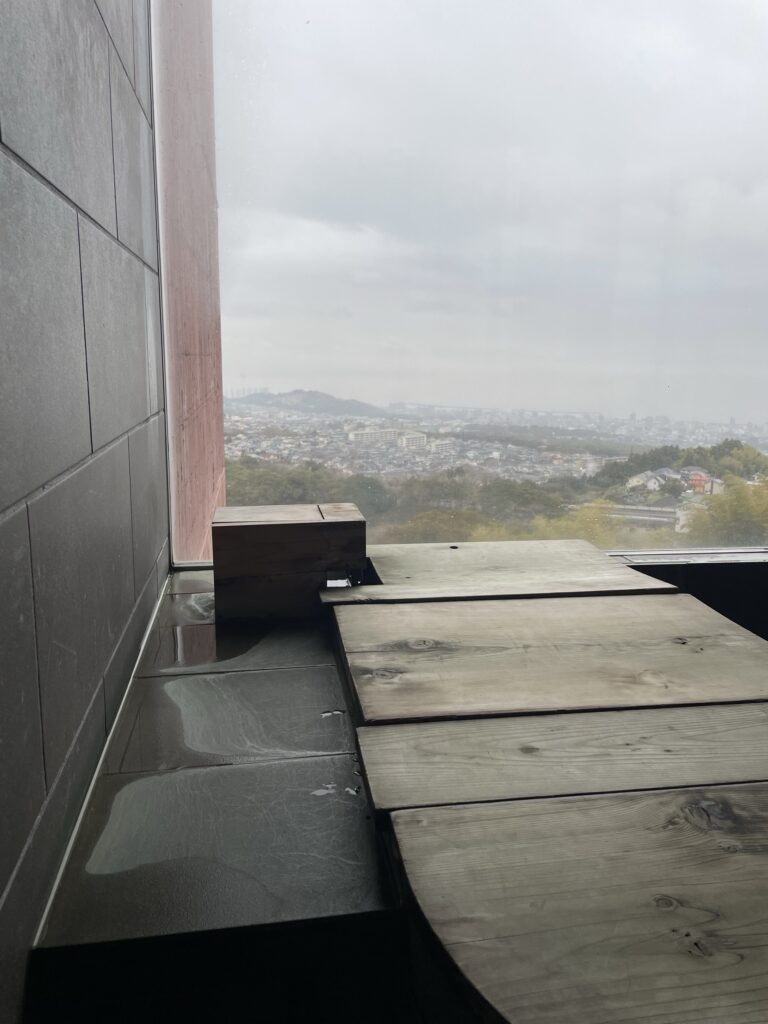
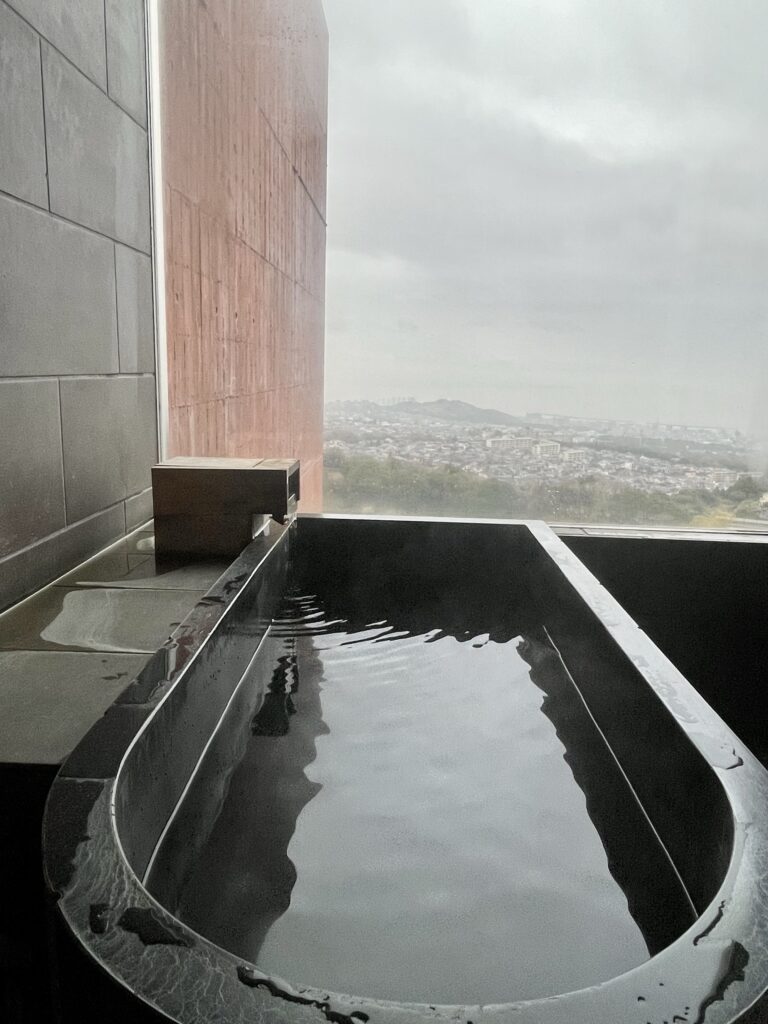
In your own room, nobody is watching and you set your own rules. You can stay in as long as you want, talk as loud as you want and bathe together. It is also the easiest way to try an onsen for the first time if being naked with strangers feels like too much. We still follow the basic onsen etiquette and wash before getting in, because the water stays nicer for longer.
When you book a private onsen in Japan, look for the words “private onsen”, “kashikiri” or “room with open-air bath”. Rooms with their own bath usually cost more than a regular room, so compare prices before you book.
Onsen Ryokan as a Vegan: Our Biggest Fail
In almost every onsen ryokan you get a yukata, a light cotton robe, which you will find folded in your room. You can wear it to the bath, in the hallways and often to dinner and breakfast too. Always wrap the left side over the right. Right over left is how the deceased are dressed in Japan. In colder months there is usually a jacket (haori) to wear on top.
A night in an onsen ryokan is the classic way to experience onsen in Japan. It usually includes dinner and breakfast, often a kaiseki dinner with many small courses. That is part of the experience, and it is where we made our biggest mistake.
We stayed at a ryokan in the countryside in Saga, not far from Arita. We had emailed in advance that we are vegan. At dinner, a full kaiseki with fish and meat arrived, and there was almost nothing we could eat. It was so uncomfortable.
We spoke to the staff in the restaurant, who sent us to the reception. At the reception, understanding each other was difficult. We tried to say that we would rather have no dinner at all than let all that food go to waste, but that did not come across either.
They said they would get back to us. Nobody did.
So we went back to the restaurant, and this time a really kind server brought us vegan options after all. Much less choice, but the official answer had basically been no, so we were really grateful.
The lesson: always ask before you book, and keep asking until you have a clear yes or a clear no. An email that says “we are vegan” is not enough if nobody confirms it. Ask specifically whether dashi made from fish is also avoided, because that is the part most kitchens miss. My guide on how to eat vegan in Japan explains why dashi is everywhere.
This is the sentence I would send to a ryokan now:
私たちはヴィーガンです。肉、魚、卵、乳製品、魚のだしを食べられません。夕食と朝食をヴィーガンで用意していただけますか?難しい場合は、食事なしのプランでも大丈夫です。
We are vegan. We cannot eat meat, fish, eggs, dairy or fish-based dashi. Could you prepare a vegan dinner and breakfast for us? If that is difficult, a plan without meals is fine too.
The last sentence matters. Offering a room-only plan gives the ryokan an easy way to say no honestly, instead of saying yes and serving fish anyway. For more ready-made sentences, see my vegan Japanese phrases for restaurants.
Onsen Tamago: Not Vegan, but Everywhere
In many hot spring towns you will see onsen tamago for sale: eggs slowly cooked in hot spring water until the white is soft and the yolk is creamy. In some places, like Hakone or Beppu, eggs are even cooked right in the steam vents. They are a classic snack at onsen in Japan, but obviously not vegan. Ryokan breakfasts often include one too, so mention it when you ask about your meals.
Foot Baths: Onsen Without Undressing
You do not always have to get naked to enjoy an onsen in Japan. In a mountain town with natural hot springs, there were public foot baths (ashiyu) right by the street. You sit down, roll up your trousers and put your feet in the hot water.
Many foot baths are free. Bring a small towel to dry your feet, wash your feet beforehand if there is a tap, and do not put anything else in the water. Foot baths are perfect if you are short on time, travelling with tattoos and no tattoo friendly onsen nearby, or simply not ready for a full onsen yet.
Popular Onsen Towns in Japan
A short list of famous places for onsen in Japan to start your planning:
- Ginzan Onsen (Yamagata): Wooden onsen ryokan along a narrow river, most famous in winter with snow.
- Kinosaki Onsen (Hyogo): Seven public bathhouses you walk between in yukata.
- Kusatsu Onsen (Gunma): Known for the steaming yubatake field in the town centre.
- Kurokawa Onsen (Kumamoto): A quiet village in the mountains of Kyushu, with a wooden pass for several outdoor baths.
- Hakone (Kanagawa): The classic onsen trip from Tokyo.
- Beppu (Oita): Hundreds of springs, steam everywhere, and a good place to find a tattoo friendly onsen.
- Kaga Onsen (Ishikawa): A group of hot spring villages, easy to combine with Kanazawa.
Where to Try an Onsen in Tokyo
You do not have to leave the city to try your first onsen in Japan. Senkyaku Banrai Toyosu Manyo Club (affiliate link) is open 24 hours and has hot spring water from Hakone and Yugawara brought in by tanker every day, so you get real onsen water with a view of the Tokyo skyline. It is rated 4.7 out of 5 from more than 1,700 reviews.
The usual onsen etiquette applies, and note the tattoo rule above: only small tattoos that two stickers can cover. We have not been there yet, so this is a tip from our planning list, not a review.
Onsen FAQ
Do you have to be naked in an onsen?
Yes, in a regular public onsen or sento you bathe completely naked. Only the small towel comes with you, and it stays out of the water. Some mixed baths allow bathing wraps, and in a private onsen you decide yourself.
Can you go to an onsen with a tattoo?
Sometimes. Many onsen in Japan still refuse tattoos, some accept small ones under cover stickers, and more and more are openly tattoo friendly. A private onsen is usually the safest option. Check each place before you go.
How long should you stay in an onsen?
Several short rounds of a few minutes each, with breaks on the edge, are better than one long soak. Drink water before and after, and skip the beer until you are done.
What is the difference between a sento and an onsen?
An onsen uses natural hot spring water that meets the legal definition. A sento is a public bathhouse that usually uses heated tap water. The onsen etiquette is the same in both.